
A commercial driving licence in BC, can take a few weeks to several months to start, depending on the licence you need, how often you train, and how quickly you can complete testing.
The biggest mistake is treating “commercial driver” as one licence. In British Columbia, a Class 1 tractor-trailer driver follows a very different training path from a Class 3 dump-truck driver or a Class 4 passenger-vehicle driver.
So, how long does it actually take?
First, choose the licence that matches the job
B.C. uses different commercial licence classes for different vehicles. ICBC lists the minimum ages as 19 for Class 1 and Class 2, 18 for Class 3, and 19 for Class 4.
| Licence | Typical Work | Training timeline |
| Class 1 | Tractor-trailers, heavy combinations | 140-hour MELT |
| Class 2 | Buses and passenger vehicles | 21 hours at Extreme Pro |
| Class 3 | Dump trucks, tow trucks and other heavy straight trucks | 30 hours at Extreme Pro |
| Class 4 | Taxis, limousines, ambulances and certain buses | 8 hours at Extreme Pro |
Class 2, 3 and 4 figures above are Extreme Professional Driver Training program durations, not provincial minimum training standards. Class 1 MELT is a B.C. licensing requirement.
For someone asking how long to become a truck driver in Canada, Class 1 is usually the relevant path if the goal is tractor-trailer work. Class 3 can make more sense for local work involving straight trucks.
The Class 1 timeline: what happens, step by step?
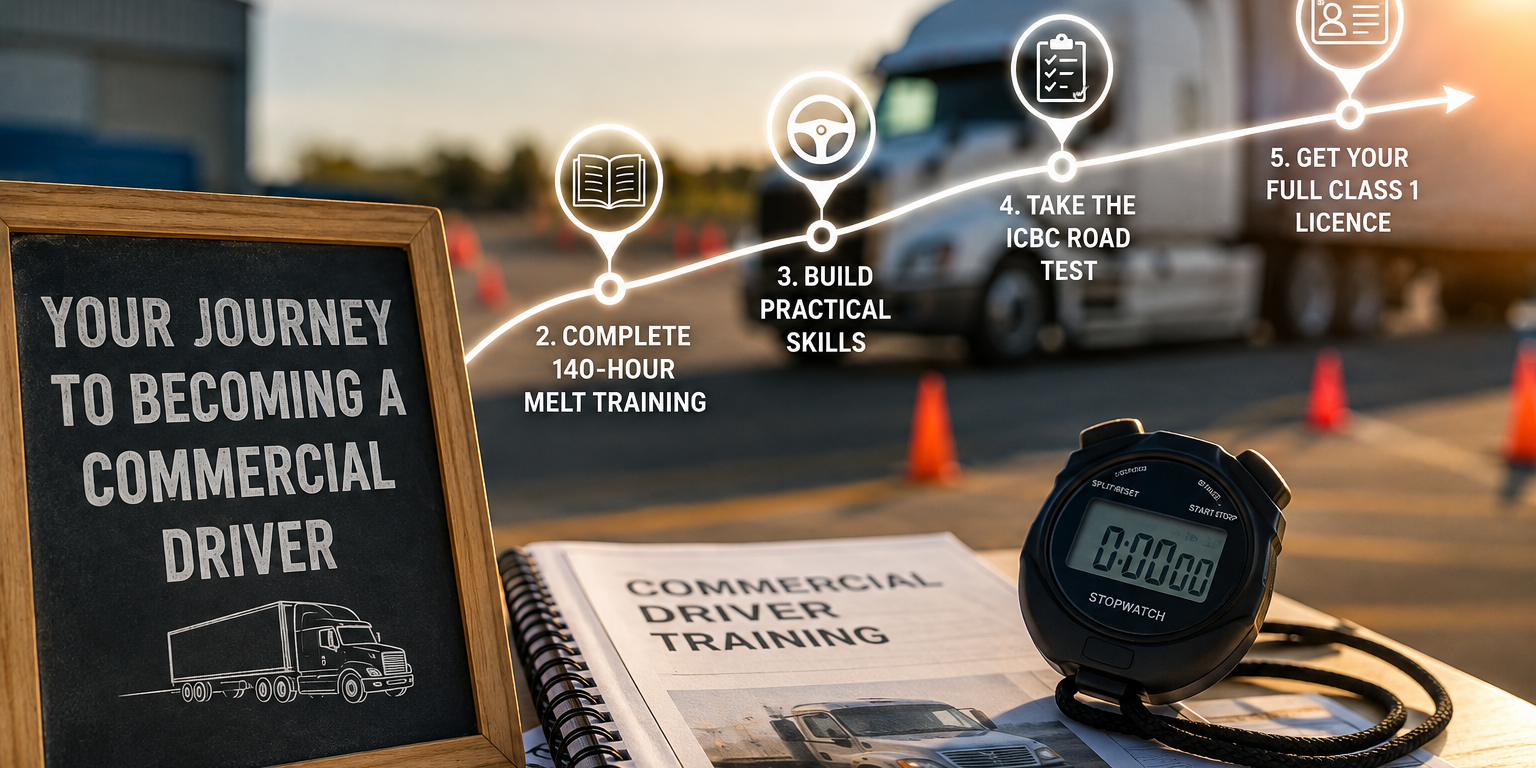
- Get your Class 1 learner’s licence
Before enrolling in B.C.’s MELT program, you need to meet the eligibility requirements, including being at least 19, holding a Class 1 learner’s licence and meeting the applicable knowledge, medical and vision requirements.
ICBC also requires commercial drivers operating applicable air-brake vehicles to have the appropriate air-brake endorsement. For Class 1, air-brake training is incorporated into MELT.
- Complete 140 hours of MELT
This is the part that makes commercial driver training in BC different from simply taking a few truck-driving lessons.
B.C.’s Class 1 MELT program is 140 hours and includes theory, in-yard training, on-highway driving, air-brake training and mandatory flexible practical training. Students have up to 12 months to complete it, although the expectation is that training will normally finish much sooner.
At Extreme Pro, students can be scheduled for 20–35 training hours per week. That means the 140 hours alone works out to roughly 4–7 weeks if training is maintained consistently.
That does not mean every student will have their full Class 1 licence in exactly 4–7 weeks. Road-test availability, preparation, personal schedules and any additional practice can extend the timeline.
- Build practical driving skills
MELT is not simply classroom time. Training covers vehicle inspections, cargo securement, hours-of-service requirements, air brakes, backing, coupling and uncoupling, chain-up procedures and professional highway driving.
That matters in B.C. because driving a tractor-trailer involves more than passing a test. Mountain roads, grades, weather and tight loading areas can all change how the vehicle needs to be handled.
- Take the ICBC road test
After completing MELT and meeting the other requirements, you can proceed to the Class 1 road test. ICBC-approved schools can provide training and, depending on the school, a suitable vehicle for the test.
Extreme Pro says its students can use its tractor-trailer for the Class 1 road test.
Once you pass, you have your Class 1 licence. Getting job-ready, however, can involve another layer of employer-specific orientation, experience or additional endorsements.
What about Class 2, 3 and 4?
The timeline can be considerably shorter.
Extreme Pro’s current programs list 21 hours for Class 2, 30 hours for its Basic Class 3 program and 8 hours for Class 4 Unrestricted training.
Those hours can translate into days or weeks depending on lesson frequency and test scheduling.
For example, Class 3 has no provincial minimum training standard comparable to Class 1 MELT. WorkBC notes that training programs commonly provide practical instruction, pre-trip preparation and road-test preparation.
Why some students finish sooner than others
The training hours are only one part of the timeline.
Three factors make a noticeable difference:
Course type: A mandatory 140-hour Class 1 MELT naturally takes longer than a short Class 4 preparation program.
Availability: Training several days a week is very different from fitting lessons around a full-time job.
Scheduling: Gaps between lessons or road-test appointments can add calendar time even when the required training hours have already been completed.
This is why a school with continuous intake and flexible scheduling can matter. Extreme Pro accepts new students continuously and offers one-on-one on-road instruction rather than splitting practical driving time between multiple students.
Is truck driving a realistic career choice in B.C.?
The labour-market numbers give useful context without promising an outcome.
WorkBC lists 15,350 projected job openings for transport truck drivers in B.C. from 2025–2035. Its current profile reports annual earnings of $68,079, while the B.C. median wage is $30.77 per hour, based on Job Bank wage data.
The Government of Canada’s Job Bank currently rates the B.C. outlook for transport truck drivers as Moderate and reported hundreds of advertised positions in August 2026.
Those figures describe the occupation, not a guaranteed result after completing training.
So, how long should you realistically plan for?
For a new Class 1 driver, think of the process as:
Learner’s licence → 140-hour MELT → practical preparation → ICBC road test → full Class 1 licence → employer-specific onboarding.
With consistent full-time training, the MELT portion can potentially be completed in around 4-7 weeks, based on Extreme Pro’s stated 20-35 hour weekly scheduling. The complete journey can take longer depending on testing and personal circumstances.
If you’re ready to start, the practical next step is to compare the B.C. Class 1 MELT program at Extreme Pro with its Class 2, Class 3 and Class 4 options. With locations in Kamloops and continuous intake, you can choose the licence that actually matches the driving work you want rather than training for a class you may not need.