

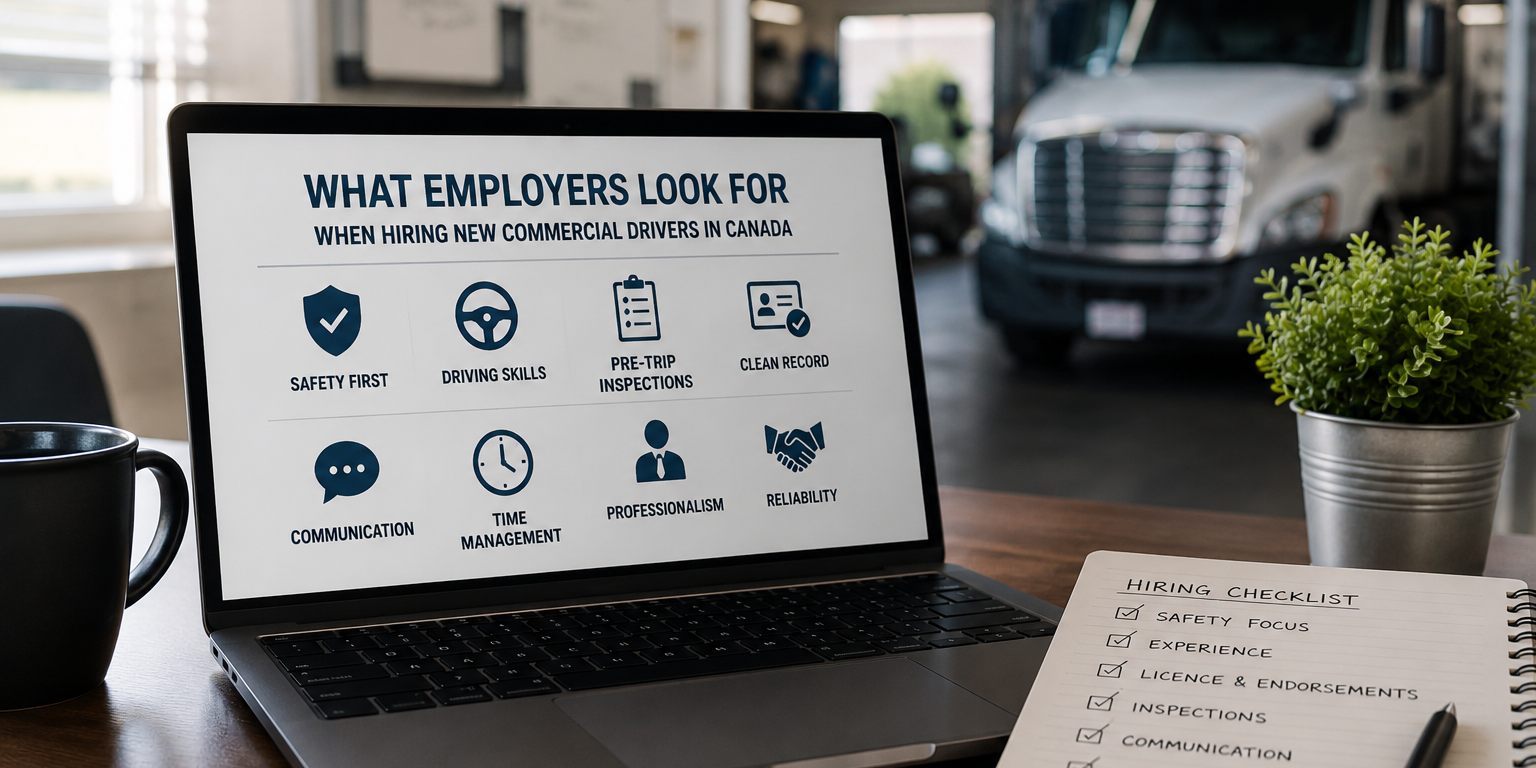
A Class 1 licence can qualify you to drive the truck, but it does not automatically convince the employers to give you the truck driving jobs in Canada.
Especially for new commercial drivers, this difference matters a lot. Canadian employers hiring for transport truck driver roles often want to understand evidence that you can operate safely, complete inspections, manage documentation, handle customers, and can handle all the responsibilities that come with moving cargo.
Job Bank has listed more than 2,000 jobs under Canada’s transport truck driver occupation, with a national median wage of $26.42 per hour. But the first job is rarely about simply showing up with the right licence.
So, what actually makes a new driver employable, and what are Canadian employers looking for while hiring a new commercial driver in Canada?
- Safety Comes Before Speed
A good employer wants a driver who understands that getting the loads delivered safely matters more than getting the loads delivered quickly.
Canadian commercial-vehicle rules are built around the National Safety Code, which covers areas including driver licensing, hours of service, cargo securement and trip inspections.
That means employers pay attention to practical safety habits:
- Following hours-of-service requirements
- Securing cargo correctly
- Identifying vehicle problems before departure
- Maintaining safe following distances
- Adjusting driving for weather and road conditions
- Knowing when a vehicle should not be operated
For a new driver, being able to explain why a safety procedure matters can be more valuable in an interview than simply saying, “I know the rules.”
- Pre-trip inspections are mandatory
A pre-trip inspection shows how seriously you take responsibility for the vehicle.
Job Bank postings for Canadian truck-driving roles commonly list pre-trip inspections and en-route and post-trip inspections among the most important and actual duties. Employers expect drivers to inspect components such as tyres, lights, air brakes, and other equipment.
If you’re asked about inspections in an interview, don’t just recite a checklist. Explain what you would do if you discovered a safety issue before leaving.
-
Documentation matters more than new drivers expect
Driving is only part of the job. Depending on the role, drivers may need to maintain logbooks, inspection reports, trip reports, bills of lading, cargo information and hours-of-service records.
Recent Canadian job postings explicitly list these documentation responsibilities.
A driver who keeps accurate records helps dispatchers, fleet managers and employers understand what happened during a trip.
Being organized is therefore a practical employability skill, not just a personality trait.
- Communication is the key
Drivers do not work alone. As a commercial driver in Canada, you may need to communicate with dispatch, warehouse staff, customers, mechanics or other drivers.
A current job posting, for example, specifically asks drivers to receive and relay information to central dispatch and lists oral and written communication among the desired qualities.
For someone who is just entering the industry, this means you need to practice clear and professional communication.
If a delivery is delayed or any mechanical problem appears, employers need someone who reports the problem early and explains it clearly.
- A clean driving record can be your greatest advantage
Employers have good reason to examine your driving history.
Recent Canadian truck-driver postings include driver-licence validity checks and driving-record checks, with some roles also requiring additional screening, such as medical exams or drug tests.
If your record is clean, make that easy for an employer to identify. If there is something on your record, don’t hide it. Be prepared to explain the circumstances honestly and professionally.
What should a new driver put on their resume?
Don’t submit a resume that only says:
“Class 1 Driver | Valid Licence | Looking for Work.”
Use the space to show what you can actually do.
Include:
| Resume section | What to show |
| Licence | Class 1/A, applicable endorsements |
| Training | Accredited driver training and relevant courses |
| Safety | Inspection, cargo securement and safety knowledge |
| Equipment | Types of trucks or trailers you’ve trained on |
| Documentation | Logbooks, inspection reports and trip documentation |
| Skills | Communication, reliability, organization and judgement |
Keep it focused. A recruiter should be able to understand your licence, training and practical abilities within seconds.
What should you expect in the interview?
Expect questions that test judgement rather than textbook knowledge.
For example:
“What would you do if you discovered a brake problem during your inspection?”
“How would you handle a delivery delay?”
“What would you do if dispatch gave you instructions you believed were unsafe?”
Don’t rush to give the answer you think the interviewer wants. Explain your reasoning, prioritize safety and show that you know when to communicate or escalate an issue.
A licence starts the career. Your habits build it.
The Canadian commercial driving market has opportunities across local, regional and long-haul work, but the requirements can differ by vehicle, province and employer. Job Bank notes that a Class 1 or A licence is generally required for long combination vehicles, while additional requirements such as air-brake or TDG certification may apply depending on the work.
That’s why the best preparation for commercial driver jobs in Canada goes beyond passing a licensing test.
If you’re considering truck driver employment in Canada, look for training that gives you practical exposure to inspections, documentation, safety procedures and professional driving expectations, not just licence preparation. A strong truck driving school in Canada like Extreme Pro should help you understand what employers will expect once training ends.