

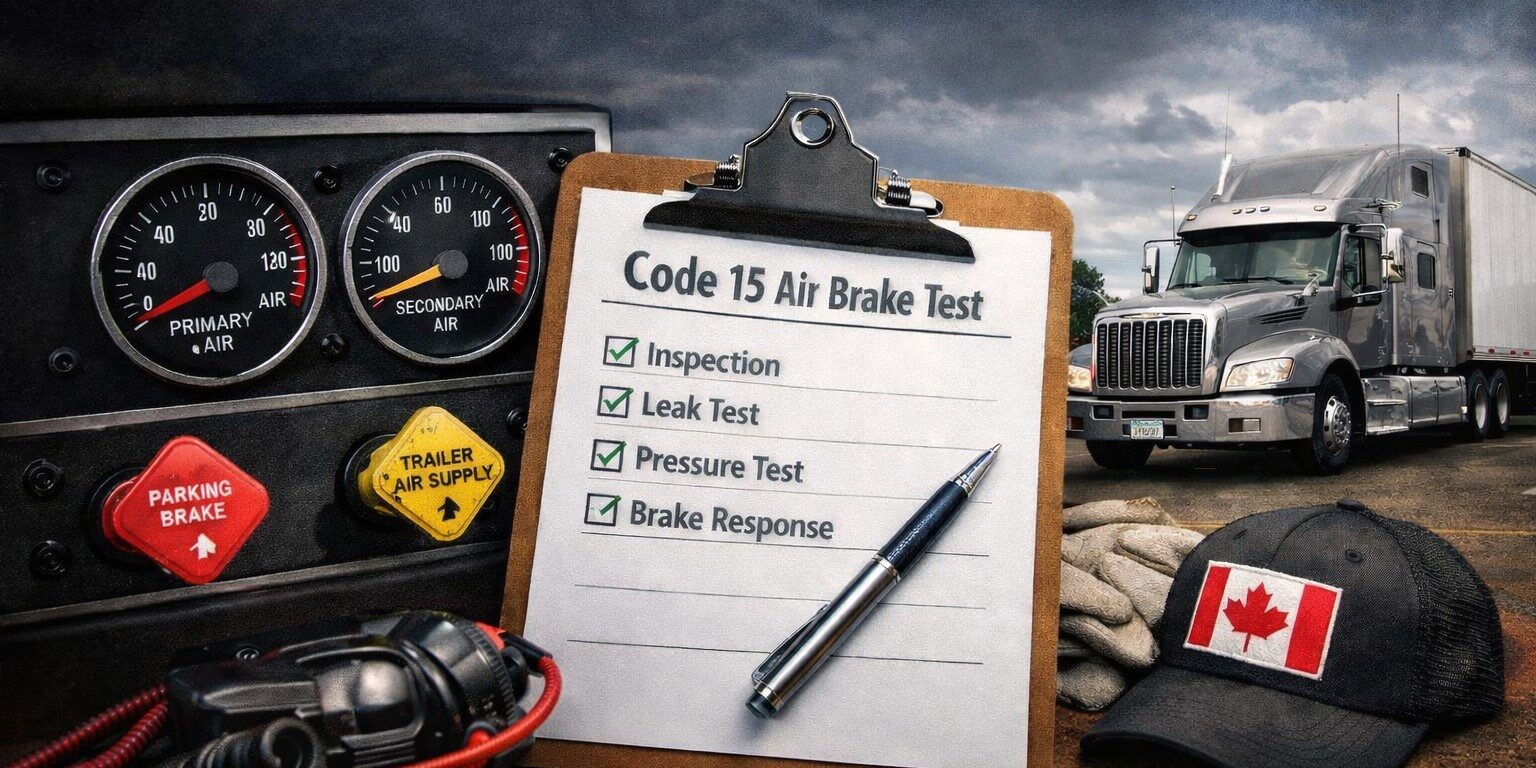
If you’re planning to drive a commercial vehicle in Canada, the Air Brake Endorsement in Canada is something you simply can’t skip.
Most heavy vehicles don’t use regular hydraulic brakes. They use air brake systems, which are powerful but more technical. And because even a small mistake can lead to serious safety risks, provinces require drivers to pass an Air Brake Test in Canada before getting behind the wheel.
Now, this test has a reputation. People say it’s tricky. Some even fail on the first attempt.
But in reality? It’s not difficult; it just operates differently.
And once you understand how the system works and have already practised it a few times, the whole process becomes less complex and more logical. So under this guide we will walk you through the complete process so you are confident about the process.
Why Air Brake Code 15 Is Required For Commercial Drivers
Big trucks don’t use the same brakes as cars. They use air brakes, which are stronger and more complex, and If something goes wrong and the driver doesn’t fully understand how the system works, it can be dangerous as well.
That’s why provinces require you to pass an air brake test in Canada before you’re allowed to drive these vehicles.
And the demand?
The demand is only going up. If you look at the recent data suggested by Trucking HR Canada, it clearly says that Canada will face a shortage of more than 30,000 truck drivers by 2030, and it shows how strong the demand is for skilled drivers right now.
Also, if we look at the average salary of a truck driver in Canada, it ranges from $55,000 to $85,000 annually, depending on routes, experience, and type of driving they do.
Source: Job Bank Canada
What Is the Air Brake Code 15 Test?
The Air Brake Code 15 Test in Canada is an additional legal certificate added to your driver’s license that allows you to regularly operate vehicles with air brakes.
In Canada most heavy-duty vehicles like transport trucks, buses and some RVs don’t use regular hydraulic brakes, they use air brakes which work differently and need some understanding. That’s why drivers are required to pass an air brake test in Canada, they can operate these vehicles safely.
Once you pass the test, it confirms three things:
- You understand how air brakes system function
- You can monitor air pressure and identify safety issues
- You can perform a pre-trip air brake inspection system
Without this endorsement you may still hold a commercial license but you won’t be legally allowed to drive vehicles with air brakes which limits your job opportunity.
Structure Of The Air Brake Code 15 Test
This is where most beginners get confused. They think it’s just a written exam. It’s not.
There are two parts.
-
Written Test
This checks your basic understanding:
- How air brakes work
- What different components do
- Safety rules.
It’s mostly multiple choice. If you study properly, this part is manageable.
-
Practical Inspection Test
This is where people panic.
You’ll be asked to:
- Do a full air brake inspection
- Check for leaks
- Show pressure build-up and drop
- You would be asked to practically explain what you’re doing
Common Topics Covered In The Test
This is the part where beginners feel overwhelmed, not because the syllabus is huge but because everything sounds technical at first.
But the air brake test in Canada really focuses on just three core areas and once you understand these, it starts to make sense.
- Understanding the Brake System: You’ll come across terms like air brakes, tanks, and chambers, but the examiner isn’t testing your memory; they want to check if you understand how the system works together. And if you can explain this in your words you are already ahead of many candidates.
- Air Pressure Monitoring: This area is where most students lose marks; you need to understand and be comfortable with: What is the safe operating pressure range? At what point does the pressure system activate? And also what happens when the pressure drops too low? And when you understand these fundamentals there is no more pressure to step into the logical side.
- Brake Safety Checks: This is the most important part of the air brake system in Canada and honestly one that decides whether you pass or fail. You will be expected to perform a proper inspection. Not rushed, not guessed. In the beginning, you may feel too many steps, but after some practice, it feels like a routine.
Comparison: Self Study Vs. Professional Training
| Factor | Self-Study | Professional Training |
| Cost | Low | Higher |
| Learning Speed | Slow | Faster |
| Practical Exposure | Limited | Hands-on |
| Confidence Level | Medium | High |
| Pass Rate | Lower | Higher |
Benefits Of Proper Training Before Taking The Test
When you go through proper truck air brake training in Canada, it stops feeling like a checklist, and it makes more sense. You are not just memorizing steps; you are learning how the system actually works.
That makes a huge difference during the air brake practice test in Canada, especially in the inspection part where most people struggle.
More importantly, it stays with you after the test. On the road, situations aren’t scripted. Weather changes, loads shift, and systems don’t always behave perfectly.
And that’s exactly why proper training matters.
Conclusion
Getting your Air Brake Code 15 Test in Canada is one of those things that feels tough at first but becomes simple once you break it down.
Focus on:
- Understanding, not memorizing
- Practicing, not guessing
- Staying calm, not rushing
If you want structured learning, programs like Extreme Pro’s 11-hour Air Brake Training Canada course give you both theory and hands-on experience. They also prepare you for the exact inspection steps required in the test.
That kind of preparation can save you multiple attempts and a lot of stress.
FAQs
-
Is the Air Brake Test In Canada difficult?
Not really. It feels hard only if you don’t practice. With proper understanding and a few practice runs, most people pass on the first or second attempt.
-
How long does it take to prepare for the Air Brake Test in Canada?
Usually 1-2 weeks is enough if you study daily and practice inspections. Training programs like Extreme Pro can speed this up.
-
Can I pass the Air Brake Test without Training?
Yes, but it’s harder. Most people don’t fail because they don’t study; they fail because they haven’t actually done it in tough times. The practical test is where most things fall apart.
-
What is the most common mistake in the Air Brake Test?
The most common mistake is people skipping steps during the inspection. Not because people don’t know them but because they rush, get nervous, or lose track midway. Even if you know everything, missing one step can cost you.
-
Is an Air Brake Endorsement worth it in Canada?
Absolutely, it opens up higher-paying driving jobs and is essential for most commercial vehicles. With demand rising, it’s a smart career move.